This short guide explains cash and simple steps you can use to protect your retirement savings. Good planning is more than growing investments — it’s about putting the right amount of cash and savings where you can reach them.
Quick action: Find one place where you can access emergency money today (a bank account or money market). If you can’t, consider moving a small amount now.
Many retirees worry about market swings, inflation, or outliving their money. Having the right cash reserves can ease these worries. This guide shows clear, practical ways to keep some money safe and still help your portfolio grow.
We will explain what “cash holdings” means, how to set up an emergency fund, and simple ways to divide your money so you do not have to sell investments at a bad time. You will get plain information on accounts, how much cash to keep, and when to talk to an advisor.
There is no one-size-fits-all answer. Your timeline, goals, monthly expenses, and comfort with risk will guide the right plan for you. We give examples you can use right away.
What you’ll learn (in plain terms)
- Why cash matters in retirement and where to keep it (easy accounts and savings).
- How much accessible money to keep for emergencies and short-term needs.
- A simple strategy to protect your portfolio from market drops.
Key Takeaways
- Cash and liquid accounts give you quick access when you need it most.
- Keeping some cash helps avoid selling investments during market swings.
- A balanced portfolio mixes cash, bonds, and stocks to match your goals.
- An emergency fund is a crucial safety net for unexpected expenses.
- The exact amount of cash depends on your retirement timeline and expenses.
- Simple rules and small steps can prevent big financial mistakes.
- If unsure, get help from a trusted advisor — and ask about tax or interest implications.
If you prefer a printed copy, use your browser’s print option. Read on for step-by-step examples and easy checklists you can use today.
Understanding Cash Holdings in Retirement
To plan well for retirement, you need easy-to-access money and a clear purpose for it. Many people overlook how much having the right cash on hand can calm worries and protect their savings.
Defining Cash Holdings and Their Role in Retirement
“Cash holdings” means more than bills in your wallet. It includes savings accounts, money market accounts, and certificates of deposit (CDs). These are sometimes called cash equivalents because you can reach them quickly when you need money.
There is also a comfort factor. Knowing you have money you can use right away reduces stress during market drops or personal surprises. That peace of mind helps you stick to a long-term investment plan.
These accounts usually earn less than stocks, but they give two important benefits: liquidity (easy access) and predictability (you know what to expect). Different accounts suit different needs — some pay a bit more interest but limit access for a short time; others are ready immediately.
Why Cash is Essential for Financial Stability
Easy-access funds are the base of a steady retirement plan. They cover everyday bills and unexpected costs so you don’t have to sell investments at the worst time.
Holding too little cash can force you to sell stocks after a market drop. Holding too much can reduce growth from investments. Both extremes can hurt your long-term plan.
What this means for you
- Peace of mind: cash covers near-term bills and unexpected medical or home costs.
- Protects your portfolio: you avoid selling investments during market downturns.
Quick example
If your monthly expenses are $3,000, a basic emergency cushion of three months would be about $9,000 in an easy-to-access account. You can adjust this number up or down based on your comfort and other income sources.
Check your accounts now: can you access $X within one day? If not, move a small amount to an account you can reach quickly. That simple step improves both your finances and your peace of mind.
Building a Balanced Retirement Portfolio
Good planning mixes different types of investments so your money can both grow and stay safe. A balanced portfolio acts like a financial safety net during changing market conditions.
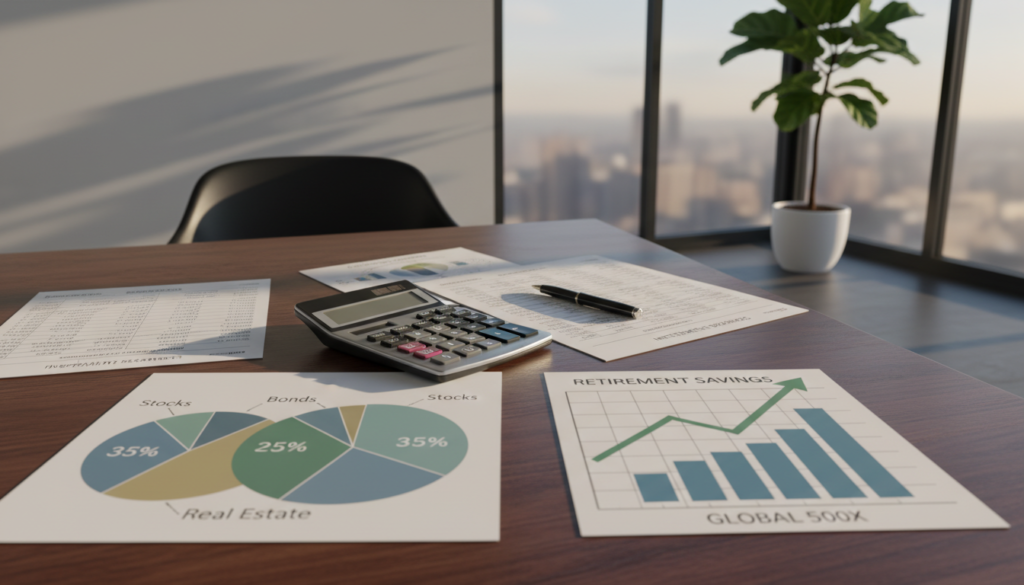
Diversification Across Stocks, Bonds, and Cash
Diversification means spreading your money across different asset types so one drop in the market won’t ruin your plan. Each part has a clear role:
- Stocks — higher return potential but more ups and downs. Best for money you won’t need right away.
- Bonds — steadier income and less volatility than stocks.
- Cash equivalents — the safest and easiest to access for near-term needs.
| Asset Class | Risk Level | Return Potential | Primary Role |
| Stocks | High | High | Growth |
| Bonds | Medium | Medium | Income & Stability |
| Cash Equivalents | Low | Low | Safety & Access |
Takeaway: A mix of stocks, bonds, and cash helps balance return potential and safety. Choose a mix that fits your goals and how much market risk you can accept.
Aligning Investment Mix With Risk Tolerance
As you get closer to or spend retirement years, many people shift toward safer investments. Your risk tolerance—how comfortable you are with market swings—should guide that change.
Simple rule-of-thumb examples (for discussion with your advisor):
- Safety-first (many retirees): 30% stocks / 40% bonds / 30% cash equivalents
- Balanced (moderate growth and safety): 40% stocks / 40% bonds / 20% cash equivalents
- Growth-oriented (comfortable with some volatility): 60% stocks / 30% bonds / 10% cash equivalents
These are examples, not rules. Your age, time horizon, income needs, and other accounts (pensions, Social Security) affect the right mix. If you feel uneasy at night about market drops, shift more toward bonds and cash.
Diversification cannot guarantee gains or prevent losses, but it gives a clearer way to manage market ups and downs. Talk to an advisor or use a simple checklist to set a mix that matches your retirement goals.
Managing Cash Reserves for Immediate Needs
Unexpected costs don’t stop when you retire. Having easy-to-access cash for those moments gives you important financial security.
Keep this safety net separate from your everyday checking account. That way you won’t spend it by accident during normal monthly payments.
Establishing an Emergency Fund
An emergency fund is money set aside for true surprises — sudden medical bills, urgent home repairs, or short-term income gaps. You need this money available quickly when something unexpected happens.
A common guideline is to keep three to six months of living expenses in an emergency fund. For example, if your monthly expenses are $5,000, that would be $15,000 to $30,000. If your expenses are $2,000 per month, aim for $6,000 to $12,000. Use the number that fits your comfort and other income sources.
Health care and home repairs can rise with age, so many retirees prefer the higher end of the range. An emergency fund reduces the chance you’ll have to sell investments during a market downturn.
Choose accounts that offer quick access and safety. Note: bank savings accounts and high-yield savings accounts are usually FDIC-insured; money market funds at brokerages are not FDIC-insured (they can still be safe but work differently). Verify insurance and access rules for any account you use.
Where to put an emergency fund — quick pros and cons
- High-yield savings account — Immediate access, FDIC-insured, moderate interest.
- Money market account (bank) — High access, FDIC-insured at banks, often higher interest.
- Money market fund (brokerage) — Easy access, may offer higher yield, not FDIC-insured.
- Short-term CDs — Higher rates, but limited access without penalty (use a CD ladder to stagger access).
- Treasury bills — Very safe, competitive yields, may have short maturities but check how to sell if you need cash quickly.
How to check and act today
- Write down your monthly expenses.
- Multiply by 3 (minimum) or 6 (more conservative) to find your target emergency amount.
- Open a separate account labeled “Emergency Fund” and set an automatic transfer each month.
If you’re unsure which account fits you best, bring this checklist to a trusted advisor or local bank and ask about access, interest, and insurance. Small steps now can protect your money and give you more peace of mind.
Mitigating Market Volatility and Sequencing Risk
Plain English: it’s not just how much your investments earn, but when those gains and losses happen. If the market falls early in retirement, regular withdrawals can do long-term damage — this is called sequencing risk.
Sequencing risk means early negative returns can shrink your nest egg so much that even later recoveries don’t make up the loss. That’s why having cash ready for the near term matters more than you might think.

Implementing the Bucket Strategy
In short: keep 1–3 years of spending in safe accounts so you don’t have to sell stocks after a big drop. The bucket strategy divides your portfolio into time-based buckets to reduce sequencing risk.
Typical buckets:
- Short-term (1–3 years): cash equivalents — for immediate expenses and peace of mind.
- Medium-term (3–10 years): bonds and stable funds — for income and moderate growth.
- Long-term (10+ years): stocks and growth investments — for capital appreciation.
Historical note: bear markets vary in length. Many are under a year, though some last longer. A 1–3 year cash buffer generally covers most downturns and gives your long-term investments time to recover.
Protecting Against Market Downturns
Use this simple action plan in a downturn:
- Withdraw from your short-term bucket for needed spending.
- Wait for markets to recover if possible — don’t sell long-term investments at low prices.
- When markets are healthier, refill the short-term bucket by taking funds from medium- or long-term holdings.
This process helps avoid locking in losses and preserves recovery potential in your portfolio.
| Bucket Type | Timeframe | Asset Types | Primary Purpose |
| Short-Term | 1-3 years | Cash equivalents | Immediate expenses & safety |
| Medium-Term | 3-10 years | Bonds & stable funds | Income & moderate growth |
| Long-Term | 10+ years | Stocks & growth assets | Capital appreciation |
“The order of returns matters as much as the average performance. Early negative returns can devastate a portfolio that’s making regular withdrawals.”
Quick example (in U.S. dollars): imagine three retirees with the same starting portfolio and withdrawal plan. If one experiences poor returns in the early years, they can end up tens of thousands of dollars worse off than another who had stronger early returns. That difference shows why timing protection matters.
Small steps you can take now: calculate one year of spending, place that amount in cash equivalents or a money market account, and label it “Short-term bucket.” Review and refill that bucket each year. These actions reduce risk and help your portfolio last through the years.
Strategies for Optimizing Cash Holdings in a Retirement Portfolio
Putting your cash in the right places helps balance safety and growth. The goal is to keep enough accessible money for near-term needs while letting the rest of your portfolio work for longer-term returns.
Selecting the Right Cash Equivalents
Experts often suggest keeping a small portion of your investment portfolio in liquid assets. Typical ranges are 2–10% for long-term portfolios, but retirees or those close to retirement may choose 5–20% depending on their situation.
Think about your timeline, other income sources (pensions, Social Security), and how comfortable you are with investment ups and downs. For example, someone retiring soon with $50,000 in annual expenses might keep $50,000–$100,000 in cash equivalents to cover 1–2 years of needs while the rest stays invested for growth.
Two simple retiree examples
- Lower expenses: If you spend $2,000 per month, aim for $6,000–$24,000 in accessible cash depending on how conservative you want to be.
- Higher expenses: If you spend $5,000 per month, consider $15,000–$60,000 as a starting point; adjust higher if you want more safety.
Expert Advice and Portfolio Adjustments
A financial advisor can help tailor these numbers to your needs and show tax-efficient moves. Advisors help pick the right accounts and explain how changes affect taxes and long-term returns.
Ask your advisor about the value of keeping some funds in easily accessed accounts versus earning higher returns in other accounts. Regular check-ins (at least once a year) help you adjust as markets and personal needs change.
Balancing Return Potential With Liquidity
Higher recent interest rates have made some liquid accounts more attractive, but accessibility and safety often matter more for near-term cash than the very best return. Decide how much you want to trade off return potential for quick access.
Here’s a quick guide to common vehicles and when they may fit your plan:
| Vehicle Type | Accessibility | Return Potential | Best For |
| High-Yield Savings | Immediate | Moderate | Emergency funds; easy access |
| Money Market Accounts (bank) | High | Good | Larger short-term reserves |
| Certificates of Deposit (CD) | Limited | Better | Staggered access with a CD ladder |
| Treasury Bills | Medium | Solid | Safety-focused short-term investments |
How to choose an account — quick checklist
- Safety: Is it FDIC-insured (bank accounts) or government-backed (Treasuries)?
- Access: How fast can you withdraw money without penalty?
- Interest: What yield do you actually receive after fees?
- Taxes: Will interest be taxable? Ask your advisor about tax-efficient placement.
Questions to ask your advisor: “How much cash should I hold now?” “Which accounts give the access I need?” “How will this affect my taxes and long-term returns?”
Small, simple steps — like setting up an emergency account and scheduling an annual review with an advisor — make a big difference for retirees who want reliable income and fewer worries about market swings.
Conclusion
In one sentence: a simple, orderly plan for cash and investments helps you feel secure and protects your money through market ups and downs.
Peace of mind in retirement comes from a plan that fits your timeline, goals, and comfort with risk. How much cash you keep depends on those things. Use short-term cash for emergencies and near-term needs, and use longer-term investments for growth and income.
Two different pots to understand (they are not the same):
- Emergency fund (short-term): 3–6 months of living expenses in an easy-access account for true surprises like medical bills.
- Sequencing-protection buffer (accessible funds): 1–3 years of spending set aside to avoid selling investments after a market drop. This is separate from your emergency fund and helps protect long-term returns.
Many retirees may want 1–3 years of spending accessible in cash equivalents to manage sequencing risk, while still keeping a 3–6 month emergency cushion for sudden needs. If those ranges seem wide, talk with an advisor to pick numbers that match your income and expenses.
A qualified financial advisor can help fine-tune your plan. They will look at your healthcare costs, tax efficiency, other accounts (pensions, Social Security), and how much risk you can handle. This personalized advice helps balance cash, bonds, and securities to meet your goals.
Simple next steps (for today)
- Write down your monthly expenses.
- Decide how many months of emergency savings you want (3–6 months) and set up an “Emergency Fund” account.
- Decide how much you want in an accessible buffer (1–3 years) to protect against market drops and label that account “Short-term bucket.”
- Schedule a conversation with a trusted advisor to review taxes, returns, and investments once a year.
Remember: past performance does not guarantee future results. This guide is information to help you plan; it is not personalized financial advice. If you need help, bring this checklist to a trusted advisor and ask the questions below.
FAQ
How much money should I keep in my savings for immediate needs during my retirement years?
What are some good types of accounts to use for my short-term funds?
How does having cash help protect my overall investment performance?
Should I adjust my strategy as I get further into retirement?
What is the bucket strategy for managing a retirement portfolio?
If you meet with an advisor — quick questions to ask
- How much cash should I hold today for emergencies and sequencing protection?
- Which accounts give the access I need and what are the tax effects?
- How often should we review my plan and adjust my portfolio?
Small actions now — writing down expenses, opening labeled accounts, and scheduling a yearly check-in with an advisor — can reduce stress and help your savings last through the years.
Leave a Reply